Screening is the systematic process of collecting student data to determine their strengths and level of risk for poor learning outcomes. Educators screen all students multiple times per year to ensure students in need of support are identified early. It can also be used as a continued systems check for Tier 1 instruction. When screening identifies a large proportion of students at risk, educators should consider strengthening Tier 1 instruction and supports in addition to intervention placement. They can evaluate their use of high-leverage practices in Tier 1, examine screening data to create an instructional plan, and intensify certain alterable variables.
To ensure students who need intervention are not over-looked, screening tools are designed to over-identify students in need of additional support. To ensure accurate identification of students, educators engage in risk verification, a process in which they use at least two additional data sources to determine if a student’s risk status is valid. While a screening measure is often a published assessment with strong psychometrics and is predictive of longer-term outcomes, risk verification measures include more informal data sources. Examples include re-administrations of the initial screening tool, measures that comprise a screening composite score, state or classroom assessments, early warning indicators, and short-term progress monitoring data.
Educators review the list of students who scored within an at-risk range on the screening measure and examine three total data sources for those students (i.e., the screening measure and two risk verification measures). Students who score “at risk” on at least two of the three data sources are flagged as needing additional support. Educators then prioritize and assign students to intervention based on their capacity and resources.
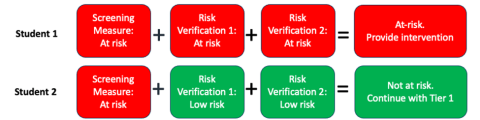
For example, in Figure 1, two students scored “at risk” after being screened with a screening tool (labeled “Screening Measure”). The educator then examined two risk verification measures, labeled “Risk Verification 1” and “Risk Verification 2.” Because Student 1 scored “at risk” on at least two of the measures, they are at risk and need intervention. Student 2, on the other hand, scored “at risk” on only one of the measures, indicating they don’t need intervention at this time. In this situation, the screener overidentified Student 2. Although the student does not currently need intervention, educators should continue to keep an eye on their progress to proactively identify and address any future concerns.
Screening and risk verification work together to support accurate, data-based decision making within Multi-Tiered System of Supports (MTSS). Screening helps identify students who may need additional support, while risk verification confirms those decisions with data triangulation. By verifying risk before assigning support, educators make more informed decisions and ensure that the students who need intervention receive them.