Have you ever looked at a progress monitoring graph and groaned because you weren’t sure how to interpret it? Or wondered whether a student was making enough growth? You’re not alone—progress monitoring can sometimes feel unclear or overwhelming.
Progress monitoring is the gathering and use of ongoing data to make decisions about student progress. It is one of the four essential components of MTSS. It is one of the most useful tools educators have for improving instruction. Educators use progress monitoring to determine the effectiveness of interventions and make timely instructional adjustments, which helps students get the right support and achieve their goals.
In this article, we share steps to make progress monitoring easier and more effective for instructional decision making.
Step 1: Choose the Right Tool
The first step in making progress monitoring work for you is selecting the right progress monitoring tool. Consider the skill you’re teaching and choose a tool that directly matches that skill. Further, use a tool that’s sensitive enough to capture growth on the specific skill you’re targeting.
Avoid “homegrown” measures that lack evidence or don’t provide reliable data. Instead, rely on established, validated tools designed for the specific type of skill you are monitoring. Visit the National Center on Intensive Intervention’s Academic Progress Monitoring Tools Chart and Behavior Progress Monitoring Tools Chart to explore validated options for progress monitoring.
Step 2: Set Achievable Goals
Once you have a reliable and valid progress monitoring tool, the next step is to set goals that are reasonable, sensible, and will catch students up to grade-level. For students with some risk or moderate risk, anchor goals to benchmark standards or expectations. For students with severe or high risk, use rate-of-improvement targets that reflect expected growth over time. This approach provides realistic yet ambitious expectations that guide intervention intensity.
Just as important, write goals in plain language that both teachers and students can understand. A simple, student-friendly goal (e.g. “I will read 120 words per minute by December”) makes the process more motivating and transparent than technical jargon. Clear goals not only improve tracking but also engage students in their own learning. Explore the MTSS Center’s Key Features of Progress Monitoring to learn more about setting goals.
Step 3: Have Clear Decision Rules
Educators use progress monitoring to make instructional adjustments while interventions are still being provided. To do this well, educators need consistent, valid decision rules that guide when to continue, fade, or intensify support.
An effective decision rule is the four-point rule. This rule gives teams a simple, consistent way to decide whether an intervention is helping a student make enough progress to reach their goal. After collecting six to nine data points, examine the most recent four data points.
If all four data points are above the goal line, then the student is making adequate progress to maintain or reach their goal. Consider fading supports or setting a more ambitious goal. The key idea is that the current intervention is working so well that the student may not need the same level of support.

If all four data points are below the goal line, then the student is not making adequate progress, and the current intervention is not sufficient. It’s time to make a change to the intervention.
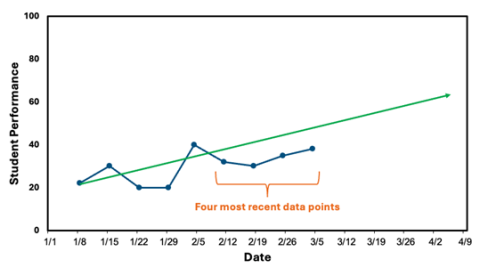
If the four data points are both above and below the goal line, then a decision about progress cannot be made. Continue with the intervention and gather more data to clarify the student’s performance.
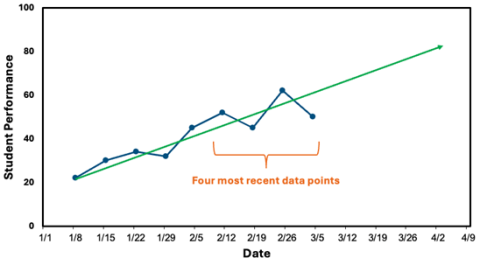
The four-point rule keeps decision-making clear and avoids the common trap of waiting too long—or changing too quickly—before adjusting instruction. Explore the Decision Rules for Analyzing Academic Progress Monitoring infographic to learn more.
Tips for Effective Progress Monitoring
Progress monitoring is most effective when it’s practical and easy to use. Here are a few tips to make it work smoothly in your school or classroom:
- Build a routine. Establish a consistent schedule for reviewing progress monitoring data (e.g., every two weeks) so it becomes a regular part of your practice.
- Streamline review. Have one person scan student graphs in advance and flag students who may need instructional adjustments. This makes meetings more focused and efficient.
- Keep it actionable. Use progress monitoring data to guide instructional decisions in real time, not just as a record-keeping exercise.
- Spread out data collection. Student performance does not have to be monitored on the same day each week. Instead, gather data from a few students each day so that time spent on progress monitoring is disbursed throughout the week.
The next time you see a progress monitoring graph, don’t groan. With the right tool, clear goals, sensible decision rules, and routines for using the data, it is a powerful component of MTSS.
Check out these resources to learn more about progress monitoring:
- MTSS Center: Progress Monitoring Overview
- Data-Based Decision Making: Using the Problem-Solving Model
- What is Progress Monitoring?