Secondary Schools

The essential components of MTSS are the same regardless of grade level or context. However, how they are translated into effective practice and integrated into a middle or high school’s processes differ from elementary schools. Secondary settings have unique contextual factors to consider, including the size, organizational culture, and age of the students. Consequently, educators consider 3 key systems that include data use, leadership, and communication.
- Data Use: Identify the key data for various teams to make decisions and enlist the leadership team to ensure corresponding teams have access to that data.
- Leadership: Develop and implement structures (e.g., teaming, communication) that ensure active engagement of staff and effectively distribute leadership responsibilities for MTSS implementation.
- Communication: Create communication pathways that build awareness and buy-in of MTSS, as well to facilitate implementation and sustainability.
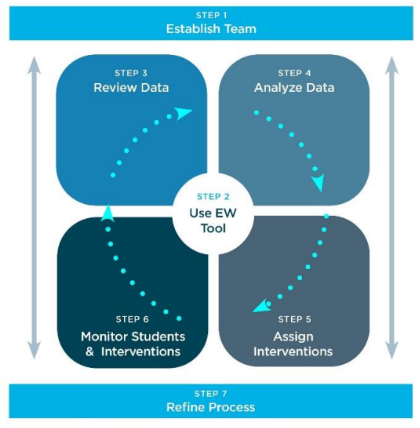
Secondary schools can use an early warning system to identify students who may be at risk for poor learning outcomes and then provide targeted support. Secondary settings can rely on early warning indicators (e.g., attendance, office referrals, course grades) as data sources to identify students who may need additional support. AIR’s Early Warning Intervention and Monitoring System (EWIMS) is an evidence-based process for identifying and monitoring students who are likely to miss key education milestones and provide supports to help get them back on track (Faria et al., 2017).
EWIMS is a systematic approach used by dedicated teams of school staff to identify students at risk of not graduating on time, assign students to interventions, and monitor their progress. By following the 7 steps of the EWIMS process, educators can turn their data into action (as illustrated in the graphic below).
By acting early, and then continuously gauging and fine-tuning support, educators following the EWIMS process can efficiently help more students succeed. To learn more about our early warning intervention and monitoring system (EWIMS) process and MTSS, please visit: https://www.air.org/resource/early-warning-systems-education.