A multi-tiered system of supports (MTSS) is a schoolwide framework that integrates data and instruction within a multi-level prevention system. This system is associated with positive academic and behavioral outcomes, higher teacher satisfaction, and improved processes (Bradshaw et al., 2008; Harlacher et al., 2024; Jimerson et al., 2016; McIntosh & Goodman, 2016). At the MTSS Center, we support educators and districts as they build an MTSS system that does four simple steps:
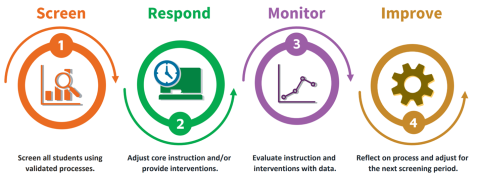
- Screen all students on a regular basis.
- Respond to that data and provide interventions to students.
- Monitor those changes using progress monitoring and fidelity data.
- Improve the processes for the next screening period
Within this article, we summarize each step and share helpful resources to support educators and districts with implementation.
Screen All Students
Screening has two important purposes. One, it helps schools identify students who may be at risk for poor learning outcomes so that they can provide additional support. Two, it helps schools examine trends at the classroom, grade, and systems levels. Reviewing these data can help the school determine if additional focus may need to be placed on improving core instruction, providing supplemental training to staff, or making adjustments to day-to-day processes.
At least twice per year, schools gather data or administer valid and reliable screening tools. This information helps schools answer the question, “Which students are at risk and in need of additional support?” Because screening tools are designed to overidentify students as at-risk, schools use a risk verification process to confirm if a student needs intervention.
To successfully screen all students, schools consider:
- Do we have screening tools that accurately predict student risk? Use our What is Screening infographic to ensure you have valid screening tools.
- Do we have a process for reviewing screening data and identifying students who need additional support? Find more information and commonly asked questions in this article by Dr. Alison Gandhi.
- Do we have a process for verifying risk? Watch our video where Dr. Rebecca Zumeta Edmonds expands on screening and verification.
Respond to the Gathered Data
Next, schools determine which interventions to provide to students. Schools should have a continuum of supports to best meet each student’s needs. At Tier 2, schools provide a standardized, evidence-based intervention for students who need additional support to master expectations or skills. For students with ongoing or more intensive needs, schools provide individualized supports at Tier 3.
To effectively perform this step and match students to interventions, schools consider:
- Do we have interventions that are evidence-based? Use our Tier 2 Intervention Evaluation Tool to ensure your interventions meet key criteria.
- Do we have an efficient process to match students to interventions based on their instructional needs? Access our Three Ways to Save Time article for examples and information on placement protocols
- Do we have methods to intensify interventions when students need more individualized support? Access our diagnostic data tools when designing Tier 3 interventions to support individualizing and intensifying interventions.
Monitor Interventions
After providing interventions, schools monitor student growth and MTSS implementation by examining both performance data and fidelity data, respectively. Performance data provides information on the impact interventions or instructional changes have for students. This may include classroom work, intervention data, and progress monitoring data. Progress monitoring is the ongoing, frequent collection and use of formal data in order to:
- Assess students’ performance;
- Quantify a student's rate of improvement or responsiveness to instruction or intervention; and
- Evaluate the effectiveness of instruction and intervention using valid and reliable measures.
For effective decision making, progress monitoring requires graphed data and a clearly defined student goal.
Fidelity data measures the extent to which practices and processes are used as intended. Fidelity data can be gathered using observations, self-report, or permanent products, such as lesson plans or student work.
With both performance and fidelity data, teams meet to evaluate interventions and make instructional decisions. To make meetings impactful, teams should have a clear agenda, defined roles, and established data-based decision making processes.
To implement this step well within MTSS, schools consider:
- Do we have reliable and valid progress monitor tools? Use our What is Progress Monitoring infographic to ensure your tools are appropriate to monitor students.
- Do we graph our progress monitoring data and have clearly defined goals for students? Examples of ways to set goals are found in our Key Features of Progress Monitoring infographic.
- Do we have effective teaming processes? Our Teaming Structures Tip Sheet offers helpful tips for effective team meetings.
- Do we have a plan and process for collecting fidelity of intervention data? Our article, Fidelity First: The Key to Unlocking MTSS, discusses how to gather and use fidelity data effectively.
- Do we have clear processes for data-based decision making? Access our infographic illustrating the four-step problem solving model and our flipbook that outlines a team process when supporting individual students. Also read our article on how to make instructional decisions with progress monitoring data.
Improve for Next Time
After gathering screening data, providing interventions, and making data-based decisions, schools may identify things to do better during the next screening period. This is a key part of MTSS! Effective implementation of MTSS demands an intentional focus on continuous improvement. If staff struggle to use certain practices or follow processes as intended, it’s likely due to a logistical barrier.
Ask these questions to determine where the breakdown is:
- Does the staff need more training or coaching to improve the use of the practice or process?
- Does the staff need more resources or support to use the practice or process as intended?
In this self‑reflective step, schools consider what is going well and what could be improved. Staff input is important, as their perspectives can help inform improvements to MTSS. Schools can gather this feedback through surveys, informal conversations, or brief focus groups.
For this step, schools consider:
- How well did we implement our screening, risk verification, and progress monitoring processes with fidelity? Are most interventions being delivered with fidelity? Access our tip sheet on fidelity for more information and helpful tips on improving fidelity.
- Are there improvements we need to make our processes more efficient for staff? We recommend examining infrastructure needed to support MTSS for this question. Access our tip sheets on infrastructure where you can find more information on leadership tips, allocating resources, and building buy-in to support MTSS.
Use MTSS to Improve Core Instruction
Within this article, we focused on providing intervention to students. However, MTSS is more than just interventions; it is a framework to improve the overall organization and effectiveness of the school. As discussed, analyzing screening data helps schools identify which students need additional support, but screening data can be used to evaluate the effectiveness of core instruction. To do so, schools examine if the majority of students are displaying grade-level behavioral expectations and academic skills.
- If the majority of students score within a “low risk” range, then schools can feel confident their core instruction is matched well to students’ needs.
- If the majority of students do not score within a “low risk” range, then schools should review data to determine how to adjust core instruction to meet most students’ needs. Often this means targeting a behavioral expectation or skill that the majority of students haven’t mastered yet or modifying aspects of the core instruction to accelerate learning. Use our Data Protocol to help develop instructional plans that address the needs of the majority of students.
Summary
MTSS can feel complicated and overwhelming at times, but it can be thought of as four simple steps: screen, respond, monitor, and improve. Contact us for detailed help with MTSS, and be sure to access our resources to support implementation:
- Multi-Tiered System of Supports: The What and The How
- Essential Components of MTSS Infographic Collection
- MTSS Infrastructure and Support Mechanisms Tip Sheets
References
Bradshaw, C. P., Koth, C. W., Bevans, K. B., Ialongo, N., & Leaf, P. J. (2008). The impact of school-wide positive behavioral interventions and supports (PBIS) on the organizational health of elementary schools. School Psychology Quarterly, 23(4), 462–473.
Harlacher, J. E., Potter, J., & Collins, A. (2024). Untangling data-based decision making: A problem-solving model to enhance MTSS. Marzano Resources.
Jimerson, S. R., Burns, M. K., & VanDerHeyden, A. M. (2016). Handbook of response to intervention. Springer.
McIntosh, K., & Goodman, S. (2016). Integrated multi-tiered systems of support: Blending RTI and PBIS. Guilford.